
I’ve never claimed to be a statistical guru or anything, but one thing I’m pretty good at is figuring out the relative validity of a given hypothesis. And I’m also pretty good at spending a lot of time wondering about random shit, especially when those things are related to football, which inevitably leads me to spending an absurd amount of time unraveling threads of data. Which I did this week. So let me share…
My initial question was essentially: “Has the NFL fundamentally changed over the past 20 years? If so, has the traditional formula for winning in the NFL also changed?”
Background: I always hated the axioms that stated: if you want to win in the NFL, you had to 1) run the ball and stop the run and 2) win the turnover battle. No ifs ands or buts about it. And I hated these axioms because 1) if taken literally, they made for tremendously boring football and 2) I simply didn’t believe them to be true. These “truisms” implied that the only way to win was to play it conservative (read: run the ball every down or throw short if you absolutely had to) and since the NFL is and has always been a conservative league of followers, these Lombardi commandments were never really seriously challenged for the first 30 or so years of the Super Bowl Era.
Sidenote: I was in junior high when the Run and Shoot Oilers came to prominence, and they were like a revelation to me. I’d always found beauty in the passing game, and Jack Pardee’s non-traditional philosophy and tactics meshed with Warren Moon’s command and accuracy to produce something so unlike anything else I’d ever seen up to that point. Communicating the depth of my feelings towards something as vague as a specific football team still remains challenging for me, but there was just something so aesthetically perfect about those Houston Oilers: the combination of their powder blue and white uniforms, Moon’s impossibly tight spirals, the diversity of body types and athleticism in the Houston receiving corps, with the beautiful timing achieved by those half roll-outs and option routes; it all touched something very central to who I was as a person at the time, and the mark it left was indelible. Perhaps it was because I wanted to empathize with the creativity and freedom the offense allowed (I was at a stifling private school at the time), or maybe it was just the implication that Jack Pardee, June Jones, and Mouse Davis were onto something that nobody else had even thought to consider yet that I could identify with so strongly. Or perhaps it was how flawless the logic was that went hand-in-hand with the Run and Shoot: teams that needed to pass for a first down would usually go with a four wideout set in order to improve their odds of converting, so why not do that every down?
Since that age range is already such a mystifying period of life to begin with, I’m still not even sure what it was in me that identified with the Run and Shoot so profoundly, but that’s essentially beside the point and is leading me into digression. My main point in mentioning them is this: people were to quick to dismiss the Run and Shoot just because of one statistically insignificant playoff game that played on the prominence fallacy in the way we think about things – people ignored the 10+ win seasons and focused on one miraculous playoff collapse (one that came at the hands of a 4-time AFC champion, I might add). The Run and Shoot was done in by sheer chance, ultimately. Well, that and the zone blitz, I guess.
But anyway, back to the question. Has the NFL changed? Has it evolved into something that better fits with my worldview? What does it take to win in the present-day NFL? Can you win with an offense that features the pass over the run?
To begin with, I took a look at trends over time in the NFL (the NFL provides the most readily available data with the least amount of outliers) and aggregated team data from the 1992, 2002, 2011 and 2012 seasons (I included two recent seasons because I feared that 2012 had two outliers: the Saints and the Colts – long story short, they didn’t skew the data all that much). Obviously, this isn’t the most scientific of analytical methods, but I do believe that a sample size consisting of all 32 teams (28 in 1992) is close enough to statistical significance that the general conclusions I reached are adequate.
Offensive Trends 1992-2012:
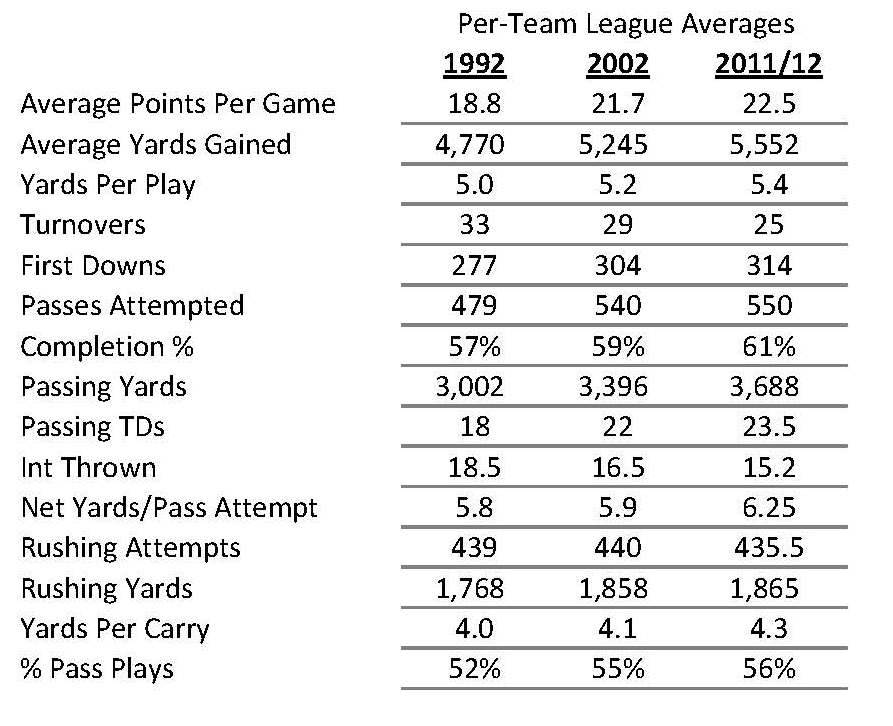
Interestingly, the above table seems to confirm the notion that the NFL has truly become more of a passing league over the years – what’s also of note is the fact that an increased emphasis on the pass has actually opened up the run game more effectively, as yards per carry seem to have improved since 1992, despite the fact that rushing attempts have remained flat, more or less. Another item worth mentioning – even though teams are passing more, they’re taking better care of the football than in the past, both by completing a higher percentage of passes and by throwing fewer interceptions.
But the important question still remains: can you win by emphasizing the pass? Does conservatism, at it was generally defined, actually work against you now? And what changed everything? I believe that the 1999 St. Louis Rams were as significant of a team in NFL history as there ever was, since they were the first Super Bowl winner to really threw the ball down the field. To me, they were the fulfillment of a Run and Shoot junkie’s long-held beliefs, they were the ones who finally broke through and validated my (increasingly marginalized) beliefs. (And yes, I know that the Coryell-born system that Martz ran wasn’t of the same family tree as the “Tiger” Ellison-born Run and Shoot. I’m talking more thematically here.)
So on to more data. If we look at the really good teams, top 25% of teams (in terms of wins) each year, do their profiles reveal anything? What I’m going for here isn’t any kind of advanced advanced metrics calculation, I’m simply looking at the teams that won the most games and describing them by their aggregate statistical measures. In other words, I wanted to see what good teams looked like, using pretty common stats, hoping that they’d be able to tell me something.
Offenses and Defenses, 25th Percentile Wins, 1992-2012


Several items stand out here. The “top” teams, record-wise, are scoring more points and gaining more yards now than they were ten and twenty years ago – but interestingly enough, they seem to be giving up far more yards than they did in the past. Top teams are gaining about 600 more yards per season than they did 20 years ago, but they’re giving up over a thousand more yards per team than they did in 1992. Another interesting finding – pass attempts shot way up by 2002, but have remained relatively stable ever since, with only net passing yards per attempt having increased significantly in the last decade. This actually aligns with the general narrative that teams employed the West Coast Offense en-masse in the early 2000s and have now transitioned into spread-out, downfield passing attacks. A final stat worth mentioning: back in 1992, the good teams really shut down the run, allowing only 3.8 yards per opponent’s rushing attempt, even though the rushing attempts allowed by the good teams have hovered at around the same mark over the past two decades.
But there was still more worth looking deeper into, and that was the extent to which the good teams outperform their competition in certain categories. I wanted to examine the differentials in what winning teams gained versus what they allowed.
Differentials, 25th Percentile Wins, 1992-2012
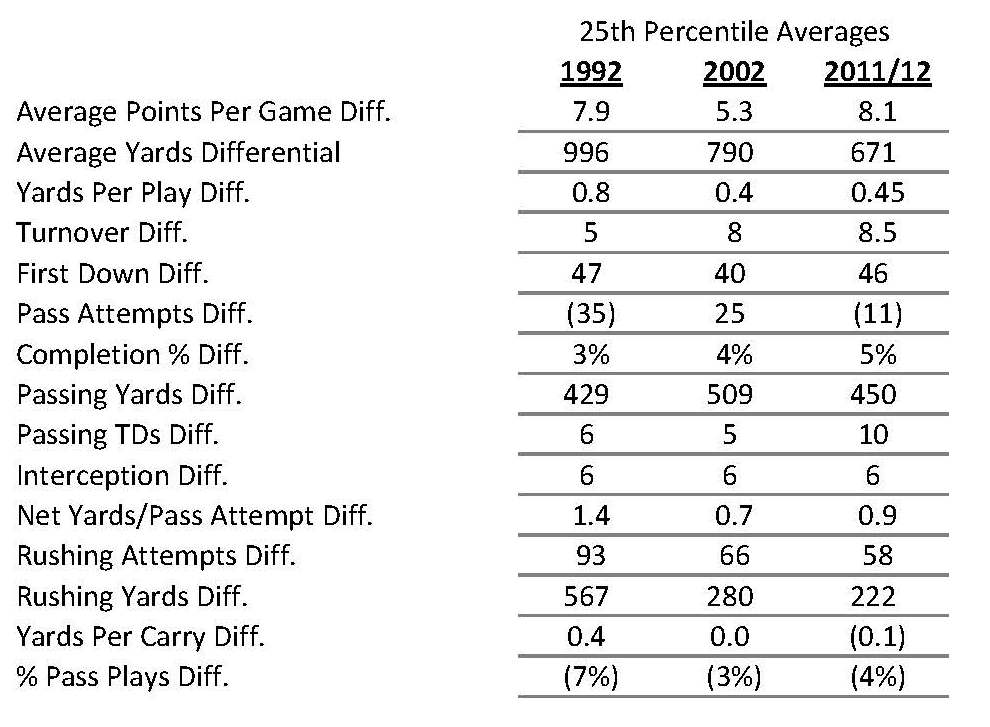
Interestingly enough, there are some clear trends over time here when it comes to differentials. But in a few statistical categories, it would seem that modern times are more in line with the good teams from twenty years ago. In terms of trends, it’s obvious that outrushing your opponent in today’s NFL doesn’t really factor in to wins and losses like it used to. As a matter of fact, top teams in the current period actually give up a higher yards per carry average than they themselves attain. Which sort of refutes the first classic axiom we discussed, the one about running the ball and stopping the run. But the second axiom about protecting the ball is the one that’s interesting. What it looks like to me is this: now that a lot of teams can throw the ball around pretty effectively, winning the turnover battle has become even more important than ever. But- interception differential has essentially remained flat through the eras, so we’re left to conclude that the good teams are forcing and recovering more fumbles than their opponents. And since we don’t have the data on who’s fumbling the ball, we have to just lay out the possibilities and what each of those implies.
1. Teams fumble on running plays and so it essentially means that running the ball has become more risky over time on a relative basis.
2. The increased number of fumbles is coming from pass rushers getting to the QB and stripping the ball LT-style, which means that before we can definitively say that the passing game reigns supreme in the NFL, teams are going to have to figure out ways to block these hybrid pass rushers and complicated blitz schemes.
NEXT: Have the “good” teams become better than they were in the past? Meaning: after normalizing against the league average for that era, are the good teams more or less dominant than before?

 Amatuer Hour - Live!
Pingback: NFL Trends By The Numbers | Pearl Town Was a Decade Ago